


How long after the wire does a real-time stock news API have the headline?
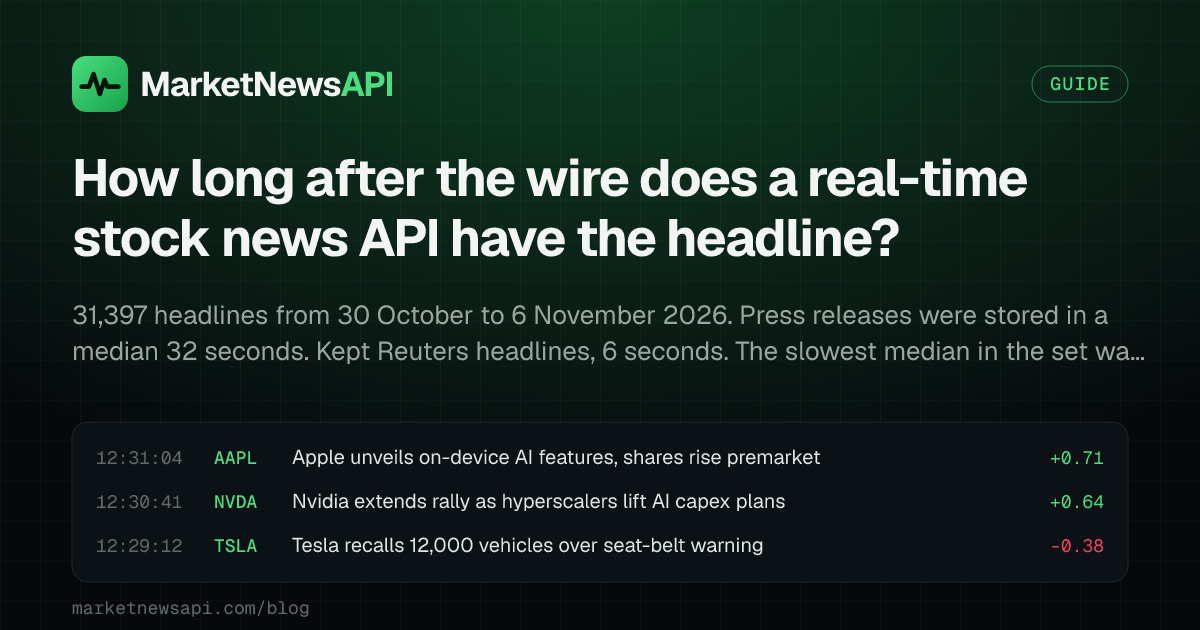
31,397 headlines from 30 October to 6 November 2026. Press releases were stored in a median 32 seconds. Kept Reuters headlines, 6 seconds. The slowest median in the set was 35 seconds.
A real-time stock news API is on time when the article is in the feed while the publisher timestamp is still fresh, and when your process hears it then. Over the week ending 6 November 2026 we timed that gap on our own index. The median press release was stored 32 seconds after the timestamp on the release. The median kept Reuters headline was stored in 6 seconds. The median article tagged simply as news took 34 seconds. The slowest median in the set was 35 seconds.
People looking for a stock news API ask for the real-time one, in those words. Google's own autocomplete, which it describes as predictions drawn from real searches, completes "stock news api" with "stock news api real time," and completes "real time stock news api" and "real-time financial news api" the same way. The price side of that question is already on this blog: how fast prices take news walks through a one-minute macro window and a 15-second stock-mention window from two published papers. This post times the other clock, the one those papers leave open. How long after the publisher's own timestamp did the API have the article?
What's in this post
- What was measured
- Press releases, news, and legal notices
- The same week, by publisher
- What a 15-minute delay does to these numbers
- What to time if you trade the headline
What was measured
The window is every article whose publisher timestamp falls from 13:51 UTC on 30 October 2026 through 13:48 UTC on 6 November 2026. That is 31,397 articles. Each one already had a stored ingest time. The lag is ingest time minus the publisher timestamp, in seconds. One article had an ingest time before its publisher timestamp and was dropped. The percentiles below are nearest-rank on the remaining 31,396. No median in this cut is slower than 35 seconds.
The publisher timestamp is the clock the source attached. It is the published_at on the article. The ingest time is when that article id was first stored. It is not a field on the public article, which is why the table cannot be rebuilt from GET /v1/news alone. A reader who wants their own figure can compare published_at with the time a WebSocket message arrives on their machine. That is a third clock, and it includes their network. This measurement stops at our store.
Publisher names are stored as they arrive. PRNewsWire and "PR Newswire" are two strings, and GlobeNewsWire and GlobeNewswire are two strings. They are not averaged together.
Press releases, news, and legal notices
The type on the article changes the answer. A trader who asks whether the API is real time, and then averages every headline, gets the speed of the commentary sites. In this week that speed is still inside 35 seconds.
| Type | Articles kept | Median | Within 60 seconds | Within 15 minutes | 90th percentile |
|---|---|---|---|---|---|
| Press release | 6,544 | 32 seconds | 100% | 100% | 35 seconds |
| News | 19,372 | 34 seconds | 100% | 100% | 35 seconds |
| Legal notice | 3,522 | 33 seconds | 100% | 100% | 35 seconds |
34 seconds is the news median. 35 seconds is the 90th percentile on news, on press releases, and on legal notices. Press releases sit a little tighter at the center, with a median of 32 seconds. Legal notices landed at 33 seconds. None of the three types has a 90th percentile past 35 seconds.
The same week, by publisher
These are the publisher strings with enough volume to read. Shares are of that publisher's rows.
| Publisher, as stored | Kept | Median | Within 15 seconds | Within 60 seconds | 90th percentile |
|---|---|---|---|---|---|
| Reuters | 3,113 | 6 seconds | 60.7% | 98.4% | 19 seconds |
| PRNewsWire | 1,341 | 11 seconds | 52.1% | 95.6% | 27 seconds |
| Business Wire | 1,351 | 23 seconds | 34.5% | 92.1% | 35 seconds |
| ACCESS Newswire | 1,749 | 17 seconds | 40.9% | 97.2% | 30 seconds |
| GlobeNewsWire | 1,529 | 21 seconds | 40.2% | 93.5% | 33 seconds |
| GlobeNewswire | 658 | 28 seconds | 11.4% | 90.8% | 35 seconds |
| Zacks Investment Research | 1,588 | 32 seconds | 0.2% | 99.1% | 34 seconds |
| Seeking Alpha | 2,348 | 25 seconds | 9.6% | 94.4% | 32 seconds |
| The Motley Fool | 1,078 | 30 seconds | 5.3% | 91.7% | 35 seconds |
| Zacks Equity Research | 2,030 | 35 seconds | 0% | 90.4% | 35 seconds |
Read Reuters as a pair. On the 3,113 headlines, the median is 6 seconds and 60.7% arrived within 15 seconds. The 90th percentile is 19 seconds. A vendor chart that quotes only the median has dropped the tenth that takes about three times as long.
The wires a company release actually moves on are not identical. PRNewsWire's median was 11 seconds, and its 90th percentile was 27 seconds. Business Wire's median was 23 seconds, with 34.5% inside 15 seconds and a 90th percentile of 35 seconds. ACCESS Newswire's median was 17 seconds and its 90th percentile was 30 seconds. GlobeNewsWire and GlobeNewswire are both in the index. Treating them as one source under-counts the feed and mixes a 21-second median with a 28-second median.
Commentary does not arrive as one speed. Seeking Alpha's median was 25 seconds, and 9.6% of its rows were inside 15 seconds. The Motley Fool's median was 30 seconds, with a 90th percentile of 35 seconds. Zacks Investment Research was 32 seconds at the median and 34 seconds at the 90th percentile, a tight band. Zacks Equity Research is the slow edge of the table: median 35 seconds, 90th percentile 35 seconds, 90.4% inside a minute, and none of its 2,030 headlines inside 15 seconds.
One source is missing from the table on purpose. Defense World had 614 kept articles, a median of 0 seconds, and 99.3% at or under 15 seconds. A median of zero means the stored publisher time matches the ingest time. That timestamp is not an independent clock, so it cannot be used as a speed.
Try it for 7 days. Signup starts Pro. A card is required. Real-time REST, WebSocket, and MCP, with 250 REST requests a day, 1 WebSocket connection, and 2,500 WebSocket messages a day. Paid Pro removes the caps. After that it's $15/month, or Free if you stop.
What a 15-minute delay does to these numbers
Free on MarketNewsAPI is the same articles, held for 15 minutes, over REST, for the last year. In this cut every headline was stored within 35 seconds of the publisher timestamp. A reader on the delayed desk waits out a clock that is longer than the ingest gap on all of them.
Pro is the live store. Paid Pro is $15 a month, or $162 a year. There is no daily request cap. A burst past 20 requests a second returns HTTP 429. The WebSocket is included, with 3 connections. The 7-day trial is the live feed, with a card. Pro is personal and internal use. A product you sell, client work, or a copy of the feed needs its own agreement. Write to [email protected].
What to time if you trade the headline
Time the type you act on. An earnings release, a guidance line, a contract, or a regulatory notice is a press release or a legal notice here. Those medians were 32 and 33 seconds, with a 90th percentile of 35 seconds. A column about the same company is the news row, median 34 seconds, and the Seeking Alpha and Motley Fool rows sit at 25 and 30 seconds. The piece on reading the release once it is public is about what is inside that text. The speed table above is about when the text was stored.
Put the price papers next to this table without pretending they are the same sample. Ederington and Lee's bulk adjustment, in the 1993 Journal of Finance paper cited in the earlier post, sat inside the first minute of a scheduled macro release. Our press-release median of 32 seconds is inside that minute, and the 90th percentile, 35 seconds, is inside it too. Busse and Green's after-cost window on positive midday CNBC mentions closed past 15 seconds. Reuters cleared 15 seconds on 60.7% of its headlines and missed it on the rest. Landing inside someone else's historical window, on a different market and a different year, is not a backtest.
Polling starts only after the article is stored. A request every 30 seconds is late by about 15 seconds on average, on top of the gaps above. A request every minute spends another half-minute. The REST and WebSocket guide is the transport choice. For a wire you want at ingest, open wss://ws.marketnewsapi.com/v1/stream and subscribe to the type. The summary socket is a later message. The WebSocket docs cover the connection.
This query is the press-release set the first table is about. The key belongs in an environment variable. published_at in the response is the publisher clock, not the ingest clock.
curl "https://api.marketnewsapi.com/v1/news?type=press_release&limit=5" \
  -H "Authorization: Bearer $MARKETNEWSAPI_KEY"
The week will not repeat these medians exactly. Sources change cadence. The split is the part worth keeping: Reuters at 6 seconds and PRNewsWire at 11 seconds are faster than a column at 33 to 35 seconds, and nothing in this table has a median past 35 seconds. The 7-day Pro trial is the live feed if you want to time the next release against your own receipt.